



In aviation, safety is always the foundation. In the reality of management, however, leaders rarely face decisions that have only a single objective. Service quality, operational efficiency, competitive pressure, and the requirements of risk control exist together in one system, creating situations in which many objectives need to be weighed at the same time.
The challenge is therefore not simply a choice between safety and service. Management capability lies in recognizing the trade-offs, understanding the impact of each decision, and finding an approach through which sustainable safety and service quality can be strengthened together over the long term.
The program on balancing policy between Safety and Service Quality (Sustainable Safety & Culture of Care) is built to develop this mindset for safety leaders and managers, especially in complex, uncertain environments with heavy operational pressure.
Program information
- Duration: 2 days
- Format: In-person training at headquarters
- Target Audience: Safety Leaders and Management Staff
- Instructor: Amel Sedaoui
- Class size: 30 participants
- Delivered for: Vietnam Airlines
When safety and service quality cannot be managed as two separate objectives
In many organizations, safety and service quality are sometimes viewed as two objectives that can conflict.
Service pressure can affect decisions related to safety. Performance requirements can create situations that call for a balance among speed, quality, and risk control. If the organization does not yet have a clear approach, decisions are easily drawn toward immediate priorities rather than a value that is optimal over the long term.
Some common challenges include:
- Service Pressure May Affect Safety
- Decisions must confront the trade-off between performance and risk control
- Lack of a clear approach to balancing the factors
- Organizational culture does not yet fully support sustainable decision-making.
This can lead to short-term choices rather than long-term optimization.
The Program Raises the Issues at a Deeper Level:how can an organization avoid continually having to “choose a side,” and instead build the capability to make decisions that strike an appropriate balance among safety, service, and operational efficiency?
Program objective: Build balanced thinking in a complex environment
The program aims to help safety leaders and managers build a mindset that balances safety and operational performance, and to understand how decisions are formed in a highly volatile environment.
Participants are given the opportunity to:
- Understand sustainable safety principles
- Identify Trade-off Situations in Practice
- Understand the role of culture in decision-making
- Develop a balanced direction suited to the organization.
Drawing on actual implementation at Vietnam Airlines, the program also places these topics in a broader context: a volatile business environment, competitive pressure, and the requirement that the organization, teams, and each individual be able to adapt while still securing the organization’s objectives and results.
Program content: Sustainable Safety & Culture of Care
The program focuses on 4 closely related content groups.
Sustainable safety principles
Participants are introduced to the objectives, principles, and approaches to sustainable safety, creating a foundation for viewing safety in relation to operations and long-term development direction.
The important point is that safety is considered not only at the moment a decision is made, but also in the ability to sustain the value of safety as the organization continually changes and develops.
Trade-offs between safety and service
In practice, there are situations in which the requirements of safety, service, and efficiency do not fully align.
The program helps participants recognize the trade-off between sustainable safety and assuring service quality, and from there consider how to balance the two factors rather than treating them by default as mutually exclusive goals.
Culture of Care
An organization's decisions are formed by more than policy or process. Culture also influences how people see a problem, what they prioritize, and how they act.
Culture of Care is included in the program as part of how the organization builds an environment that supports more balanced and sustainable decisions.
Balancing strategy in operations
From principle to practice, the program aims to build an approach that helps the organization balance safety and service quality during operations.
Rather than treating each trade-off as an isolated situation, leaders need to see the relationship between decisions and the organization's long-term direction.
From “trade-off” to “synergy” between safety and service quality
When people speak of a trade-off, they often picture that gaining more on one side requires sacrificing the other. A more mature approach is to ask:Can operations be designed so that safety and service quality support each other?
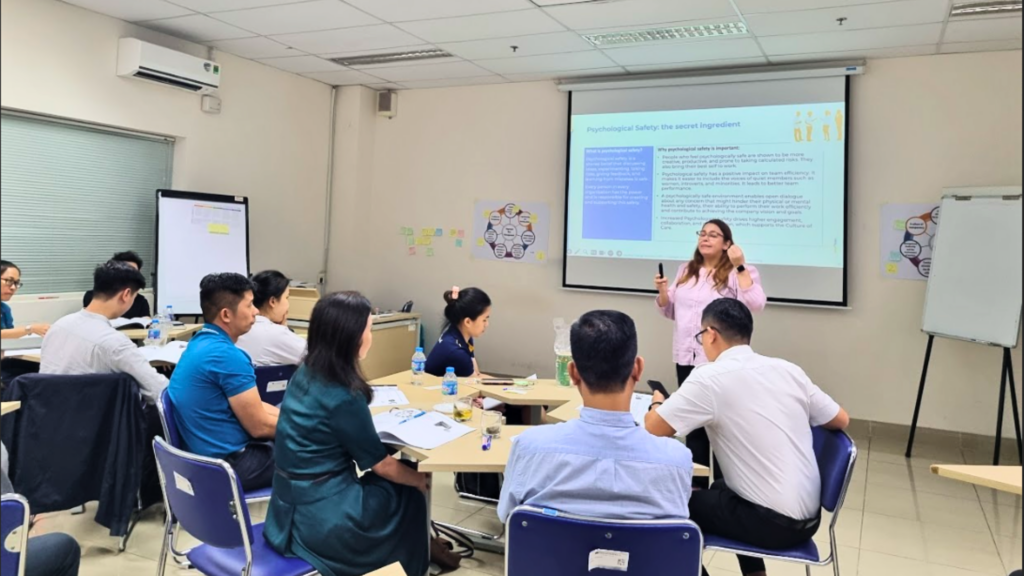
In the program at Vietnam Airlines, participants exchanged views on how to balance sustainable safety and service quality in order to create synergy.
This problem is also set in a very specific management context at Vietnam Airlines: balancing the relationship between the safety maturity goal at the Advanced - Generative 5.0 level and the direction of upgrading to 5-star Skytrax service.
What is notable does not lie in the two goals taken separately, but in the organization's ability to pursue high goals for safety and service without turning them into two competing directions of development.
Delivery method: Place leaders in situations that require genuine consideration
Aimed at safety leaders and managers, the program does not focus only on conveying theory. Group discussion, exchange, and interaction play an important role in delivery. Guided by the instructor, participants analyze situations that require a balance between sustainable safety and service quality, and thereby clarify the objective, the principles, and the approach of each option.
What matters is that the program creates space for leaders not only to ask “What should be prioritized in this situation?” but to go further“What kind of approach does an organization need so that similar decisions are made consistently and sustainably?”.This is the shift from handling each trade-off individually to building decision-making capability at the organizational level.
Value gained after the program
The value of the program lies in helping leadership and management view safety, service quality, and operational performance within the same management problem, rather than treating them as independent objectives.
After the program, participants will be able to:
- Understand How to Balance Safety and Service
- Identify situations that require trade-offs
- Make Appropriate Decisions in a Real-World Context
- Build a Long-Term and Sustainable Approach.
Balance therefore lies not only in a specific decision, but is placed in relation to culture, adaptability, and the organization's long-term objectives.
Which units is the program suitable for?
The program suits organizations whose management teams regularly have to weigh requirements for safety, service, and operational performance at the same time.
Suitable participants include:
- Middle- and senior-level leaders and managers
- Organizations with High Requirements for Service and Safety
- Enterprises need to optimize operational performance while still ensuring safety.
In particular, the program matters for organizations that want to move beyond the “safety or efficiency” way of thinking, toward an approach in which several objectives can be balanced over the long term.
Balancing safety and efficiency is not a choice but an organizational capability
Organizations with high requirements for safety cannot overlook service quality and operational performance. Conversely, organizations that pursue customer experience and high performance also cannot treat safety as a limit that must be “traded off” when pressure increases.
Real capability lies in the ability to recognize trade-off points, adapt to context, and design decisions aligned with the organization's long-term objectives.
Hung Viet helps organizations clarify the trade-offs in operations, build a suitable approach, and connect safety with business objectives. Through this, the balance between safety and efficiency gradually becomes a management capability of the organization, rather than only a way of resolving each situation on its own.