


The program provides the principles and skills to implement the safety risk management process (Safety Risk Management) within the Safety Management System (SMS), enabling participants to approach hazard identification, risk assessment, and risk control in operations in a systematic way.
Delivered for: Vietnam Airlines
Program information
- Duration: 4 days
- Format: In person, classroom-based
- Audience: Managers and safety specialists
- Instructor: Risk expert
- Class size: 30 participants
Why does safety risk management need to be implemented systematically?
Risk management in many organizations still lacks a systematic and consistent approach. The challenge lies not only in identifying each risk in isolation, but also in connecting the steps of the process and coordinating among stakeholders.
In many organizations:
- Incomplete hazard identification
- Risk assessment does not yet follow a clear methodology
- Lack of linkage between the steps in the risk management process
- Coordination among departments remains limited.
This means risk control does not yet achieve the desired effectiveness. Safety risk management therefore needs to be approached as a process that links hazard identification, risk assessment, risk control, and the involvement of stakeholders.
Safety Risk Management program objectives
The program focuses on building the capability to implement safety risk management in a structured way, enabling participants to:
- Understand the risk management process within the SMS
- Identify hazards in operations
- Carry out risk assessment and risk control
- Understand the role of stakeholders in risk management.
Program content
The program focuses on the following topics:
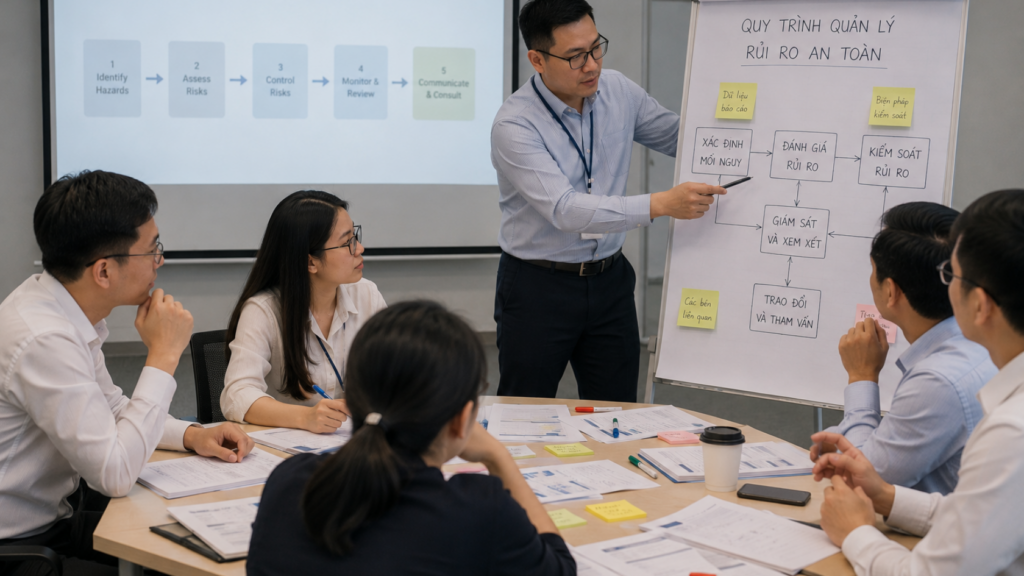
- Risk management process
- Hazard identification
- Risk assessment
- Risk control
- Coordinating with stakeholders
- Practical examples at Vietnam Airlines
The content is built around the risk management process, helping participants understand the relationship between hazard identification, assessment, risk control, and stakeholder coordination during implementation.
Delivery approach
The course is delivered by combining theory and practice, applied to specific risk situations, helping participants connect knowledge and methods with concrete situations.
Value gained after the program
After completing the program, participants can:
- Understand and apply the risk management process
- Identify and assess risks in operations
- Recommend appropriate control measures
- Enhancing the effectiveness of safety management.

The program aims to help participants not only understand each step in isolation, but also approach risk management as a systematic process, from hazard identification and risk assessment to recommending appropriate control measures.
Which units is the program suitable for?
The program is suitable for:
- Organizations implementing or refining an SMS
- Safety management and specialist teams
- Units that need to standardize the risk management process.
Tailor the program to operational characteristics
Risk management needs to fit the operational characteristics of each organization. Differences in the type of activity, the maturity of the system, and the actual context require training content and an approach that fit.
Hung Viet adapts the content to the type of activity, designs the program based on the current maturity of the system, and tailors practice scenarios to the actual context, so that the training content aligns more closely with each organization's operations.