


A reporting culture in the corporate environment is the way people can report operational management issues fully and immediately, without fear of punishment, whether the cause is objective or subjective.

"Reporting culture is the root of corporate culture" - theo Prof. Phan Van Truong(international negotiation expert, advisor toFrench Governmentin International trade,Legion of Honour).
To build an effective, transparent corporate culture, every report must be respected, reviewed, and handled seriously. The reporter's identity will be kept confidential (if needed).
What is a reporting culture?
In the entrenched bureaucratic way of working typical of Vietnamese enterprises, a reporting culture is usually given little attention, and leaders and employees do not understand why this culture is necessary. In developed economies, by contrast, enterprises always treat reporting as a vital element, and as something entirely necessary.
- Reporting helps build a work information system, measure progress, detect incidents and risks, and foster team and community relationships.
- Reporting prevents mistakes from being repeated by clarifying the causes, signs, and outcomes of a series of wrong actions. From that, a solution is found for each problem, and each employee's creativity is strengthened.
- Reporting is the only form of communication that brings together all 5 elements:timely, concise, accurate, completeandwith systematic coordination in writing. It requires everyone to speak up, exposing people who lack motivation or capability. It creates a healthy, safe business and working environment.
- A reporting culture creates equality (leaders included), holds people to their responsibility, creates urgency to act, resolves difficult problems, and drives collective action. Reporting begins"leaders must govern, subordinates must manage".
- A reporting culture is not only an important part of management and decision-making. It also expresses the business philosophy and core values of an enterprise or organization in the era of digitization and international economic integration, and it rejects ineffective bureaucracy.
Collecting, analyzing, and reporting information has become a decisive factor in the success of every enterprise. Building an effective reporting culture, however, is no small challenge. It calls for progressive processes together with people determined to improve, working jointly to create an environment in which everyone can readily access information and use it to make the right decisions for the organization.
Reporting culture makes the difference

A reporting culture is different from ordinary reporting. It is not merely reporting the positive side, in a self-promotional way, and reporting only to one's own leader.
A reporting culture means making public every wrongdoing and every mistake by any member of staff or any leader, without the person who reports being disciplined or punished. Everyone understands the case and the issue so that they can take part in resolving it, and they know the direction the company or organization is taking to resolve it.
Example:3 employees take part together in one customer meeting. An ordinary report needs only 1 representative, reporting to a manager or the company director. A reporting culture requires all 3 employees to report, because each person’s point of view is different. Employee A may report that the meeting went well and the customer was satisfied.
Employees B and C, however, considered that the partner had many problems and an attitude of disagreement, yet they had not said so directly in the meeting. Clearly, if all 3 employees are free to report, the overall picture of the same 1 event changes completely. The manager then has a more multi-sided view and can look into what, in the company’s product or service, left the customer less than satisfied. This will help the company develop and improve.
Reporting culture: the foundation of corporate safety culture
Effective reporting, which avoids distortion, triviality, and token compliance, helps build a continuous base of information, supplemented regularly by every employee and officer (regardless of rank, duty, or department) in the organization. Processing and protecting the safety information base is very important in order to assure continuity, accuracy, and credibility.
A reporting culture creates a supply of information related to each person, each technical factor, the organizational structure, the operating environment, and so on — the factors that determine the safety of the whole system. Continuous reporting helps identify and manage risk quickly and effectively, supports timely decisions, and helps monitor, analyze, and investigate accidents and safety occurrences.
Moreover, this is an important means of improving the management system, and one of the decisive elements for assessing how positive and how effective the safety culture is in a company or organization.
The Close Relationship Among the Elements of Safety
Theo IATA(International Air Transport Association), the 5 elements of safety culture include:Integrity Culture, Informed Culture, Learning Culture, Flexible Adaptive CultureandReporting culture.
- Start with a culture of integrity: A reporting culture is effective only when the company or organization acts with integrity and transparency. Whether reporting is effective depends on how leaders and colleagues respond to mistakes and to discipline.
Employees will refuse to report voluntarily,"turn a blind eye"if their colleagues are always severely disciplined for honestly reporting operational lapses, even system errors that lie outside an individual's control.
Errors that are intentional, however, or that are caused by negligent or destructive behavior, must still be punished severely, and may require compensation, a lawsuit, or dismissal. A culture of integrity has a code of conduct that clearly sets the boundary between acceptable and unacceptable actions. Open, honest reports are especially necessary for safety management, for forecasting hazards and risks, or for investigating a safety occurrence or a workplace accident, helping the company remedy the situation in time and reduce losses and harm to its business reputation.
Employee reports need to be assessed seriously and impartially, without bias, from a systems perspective, rather than being considered from a personal point of view.
- Information culture: Safety data and information are collected from reports in order to maintain and improve the system of safe operations. Put another way, a reporting culture grows strong together with an information culture. Through regular reporting, personnel gain further knowledge, skills, and work experience, an understanding of how to identify hazards and risks, and the timely application of necessary changes, assuring operational safety.
- The 3rd is a learning culture: Access to useful information from timely and accurate reports helps form a learning mindset and the habit of drawing lessons from the mistakes of others and of oneself. This also benefits the company’s training courses for its personnel.
- Flexible adaptability: The operating environment is always changing, with the advance of technology, the replacement of production lines, and volatility in the business market. Collecting, analyzing, and processing information, and reporting in a timely and continuous way, helps leaders and managers make decisions that fit actual requirements, and helps the company or organization overcome difficulties and develop with strength.

Signs of successfully building a Reporting Culture
- Employees always trust the leadership and department heads, are fully trained in hazard identification and risk management, and have access to a quality safety management system.
- A reporting culture that is transparent and impartial, free of punishment, with anonymous reporting strongly encouraged, the reporter’s identity kept confidential, a positive response and encouragement always received, and no jealousy or resentment between the person who reports and the person who is reported. Timely, accurate reports are rewarded.
- Build a reporting and report-handling process that is simple, streamlined, and easy to access.
The above are 3 expressions of a positive reporting culture. It can be said that responsibility for safety reporting belongs to every member of staff, in every field and at every level of the company and the organization.
The leadership and managers at every level need to build trust and encourage personnel to report actively and to detect hazards and dangerous occurrences that affect safety. As with safety culture, building a reporting culture demands a long process, and the perseverance and determination of the whole organization, in order to change mindsets and awareness and to build trust and a sense of responsibility in each individual.
Building a Reporting Culture: Hung Viet Consulting accompanies Vietnam Airlines
On 11/10/2024 at Flamingo Dai Lai Resort, Vinh Phuc,Vietnam Airlines Corporation (Vietnam Airlines)organized"Safety Reporting Culture Workshop"with the participation of senior leaders in the aviation industry. The event once again strengthened awareness and the management of safety risks in flight operations.

The seminar focused on important topics such as risk management in aircraft maintenance, control of foreign object debris on the runway, fire and explosion prevention, technical safety management, and the operation of new routes. It emphasized the importance of transparency and a sense of responsibility in reporting safety issues.
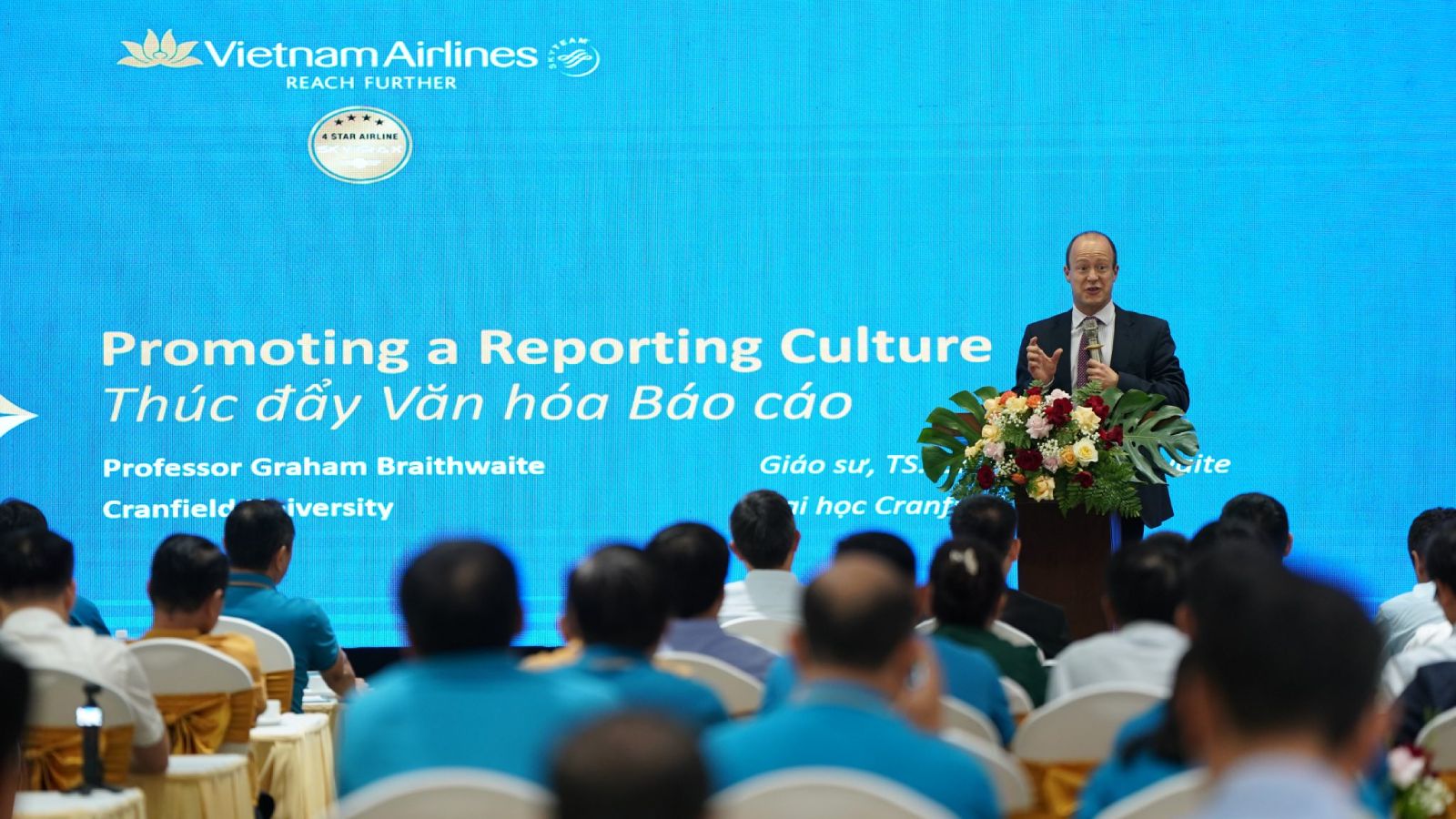
"Safety Reporting Culture Workshop 2024"not only affirms that Vietnam Airlines continues to uphold its commitments to flight safety, strengthen cooperation among parties in the industry, and work toward a sustainable safety environment. This is also an important event marking more than 6 years of partnership byHung Viet Consultingin efforts to strengthen Safety Culture"Safety First - aiming to approach level 5.0 by 2025"of Vietnam Airlines.
Over the past 1 decade, the safety reporting system of Vietnam Airlines and its member companies has been continuously improved, from processes through to methods of reporting. A Code of Conduct has been established for the voluntary reporting of technical faults and operational errors.
The number of voluntary reports rose steadily and continuously, from 93 in 2014 to 613 reports only 3 years later (in 2017). The assessment and handling of safety reports also made notable progress, including the issuance of investigation reports on maintenance errors, quality and safety notices, revisions to internal procedures, and the identification of hazards.
Hung Viet Consulting has worked alongside Vietnam Airlines to build a safety culture that reached the Proactive level (4.0) in 2020, with a direction to advance to the Advanced level (5.0) in 2025. The national airline’s reporting culture is set to reach the milestone of 5,000 voluntary reports in 2025.