


The most horrific disaster in world aviation in 2024 occurred on the eve of the new year - on 02/01.
A Japan Airlines (JAL) Airbus A350 commercial aircraft (flight number JL516), flying from New Chitose Airport (Sapporo, the capital of Hokkaido) to Haneda Airport (Tokyo), unexpectedly collided with a Japan Coast Guard aircraft on landing, causing the A350 to catch fire and explode.
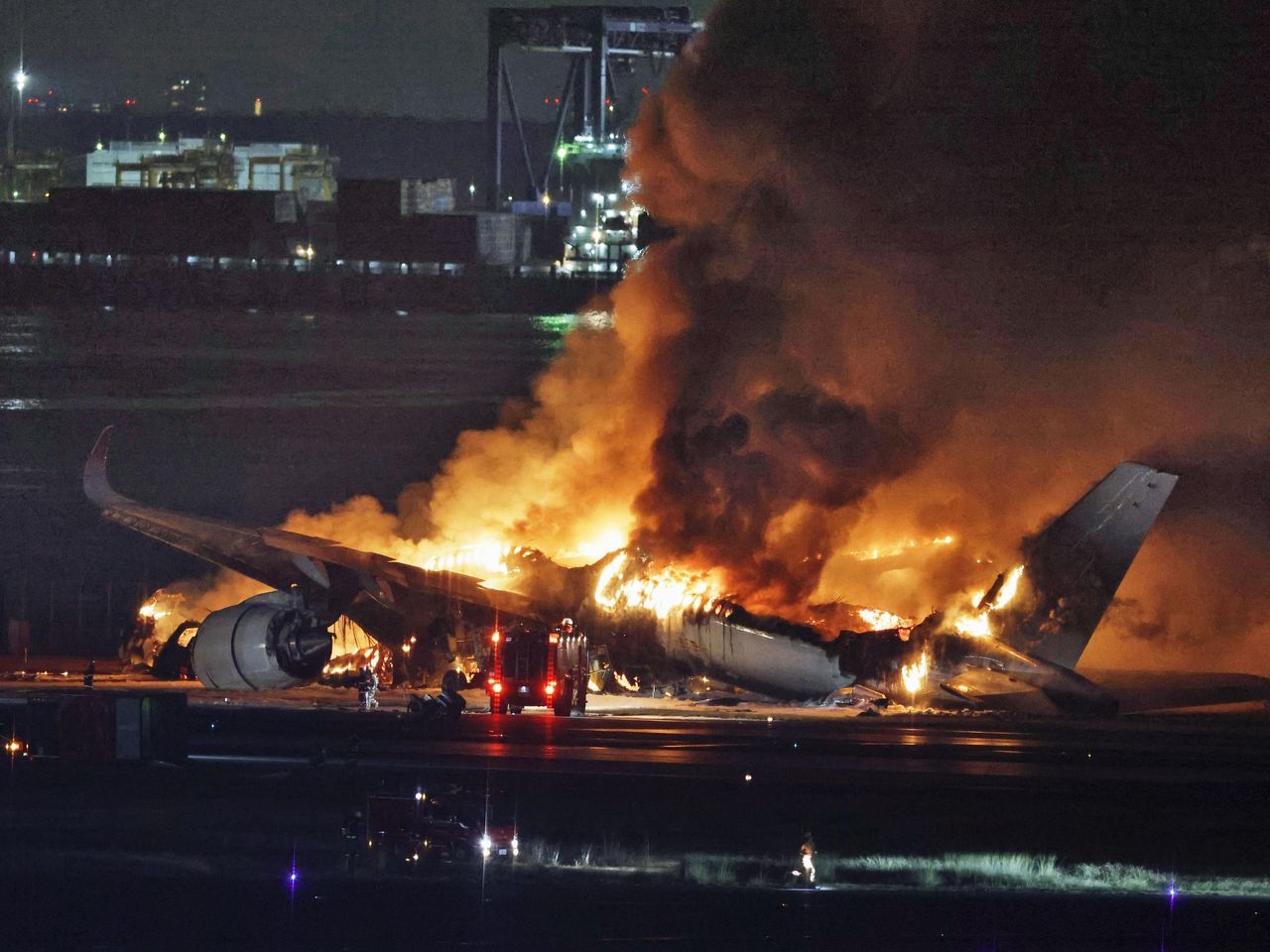
As of 04/01/2024, the casualties were 05 dead and 17 injured, all members of the Coast Guard. Notably, all 367 passengers and 12 crew members of the A350 were evacuated safely in a brief 90 s.
Summary of the Airbus A350 Disaster, Flight Number JL516
|
Accident aircraft A (JL516 - A359) |
Accident aircraft B (Dash-8) |
|
|
Haneda International Airport is known as the busiest airport in the Land of the Rising Sun.
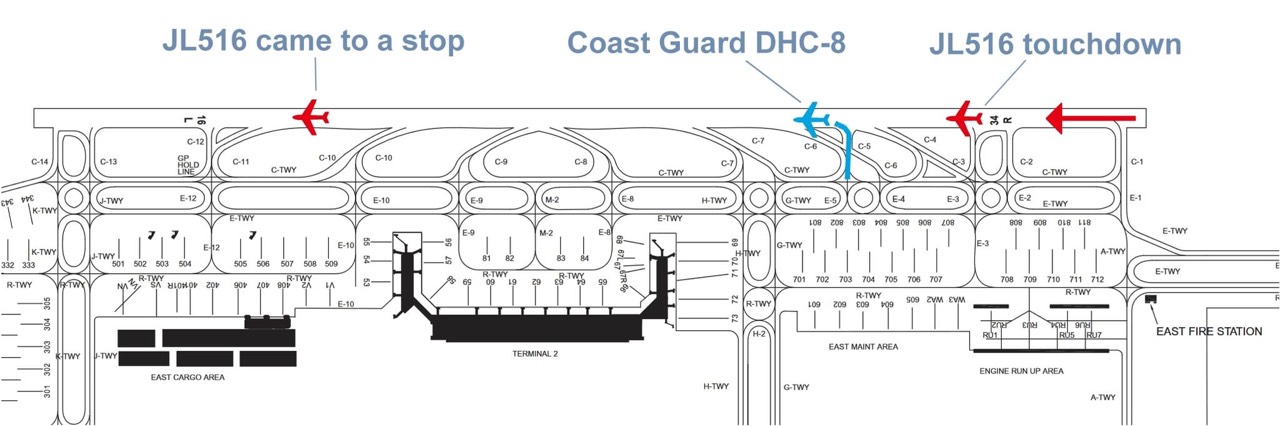
Detailed sequence of events:
Weather: Wind direction varying from 320° to 30°, speed 5 knots (2,5m/s). Visibility exceeding 10km, few clouds, temperature 7°C, dew point -3°C.
- 17:44: Aircraft A (JL516) received landing clearance.
- 17h47: JL516 landed.
- 17h47:32: Aircraft B encountered an incident; this was identified as the moment of the collision.
After the collision, JL516 lost its nose landing gear and slid along on its nose, throwing sparks the whole way; the right engine struck a foreign object and caught fire, and the aircraft ran off the right side of the runway.
When JL516 came to a stop, the slides were deployed and all passengers were evacuated successfully. The left engine then exploded, and JL516 was almost completely burned out. The scene was extremely horrific.
The fate of the Japan Coast Guard Dash-8 was far more severe: it broke apart on the spot and exploded violently, and only 1 person, the captain, survived among the 6 people on board.
Preliminary conclusion:
Based on the cockpit voice recording, the initial conclusion was that the captain of JL516 had received clear landing clearance from the tower and therefore was not legally liable.
The Japan Coast Guard Dash-8 had only been instructed to move to a holding point near the runway and had not been cleared for takeoff, yet the Dash-8 entered the runway hastily, causing the collision.
This was an especially serious accident, the first in which an advanced aircraft of the A350 family was completely destroyed. Fortunately, all 367 passengers and 12 crew members were safe.
Analysis of the application of aviation safety standards in the case
Aviation fire prevention and fighting (PCCC) standards require that, within 5 minutes after a fire occurs, components, piping, and fuel transfer can still maintain basic operation, ensuring the fire does not spread.
Within 10 minutes, fire will not spread through the fuel tanks, lines, and components that contain and carry fuel, giving the pilots time to respond, or to land and evacuate.
Many aircraft fire and explosion accidents are related to the engine compartment; once a fire breaks out, older engines often lose the ability to operate and may even explode.
The skin is typically made of aluminum alloy, with a maximum melting temperature of only about 600 degrees. Meanwhile, the fire prevention and firefighting (PCCC) requirements ofFAA(U.S. Federal Aviation Administration) must withstand a high temperature of 1093 degrees continuously for 15 minutes, so only modern aircraft types meet this requirement.
According to the video recorded as JL516 landed, it appeared to be fully ablaze as it hurtled down the runway; it is hard to believe that anyone left the aircraft uninjured.
However, the fuselage of JL516 withstood the flames for up to18 minutesfrom the moment of touchdown (starting at 5:47 p.m. until the last person left the aircraft at 6:05). The aircraft slid about 2/3 of a mile down the runway before coming to a stop, and the evacuation slides could be deployed.
Engineers calculated that the bulkhead could fail after 10,000 flights. And JL516 met with disaster on its 12,219th flight.
It can be said that the technical features of this Airbus A350-900, which was 2.3 years old, such as the firewalls around the engines, the nitrogen pumps in the fuel tanks, and the fire-resistant materials on the seats and the floor, may well have kept the fire from breaking out in the cabin, giving the passengers on the flight more time to evacuate.
When the aircraft caught fire, the crew opened only 3 of the 8 emergency exits, a response commonly seen in drills.
JL516 had 4 escape routes on each side of the aircraft, including passenger doors and emergency exits, for a total of 8 exits.
After the aircraft stopped, the right-hand engine was on fire and the fuselage was not yet fully ablaze. The crew made a correct choice, opening only 2 aircraft doors at the front and 1 aircraft door on the left rear.
This is one of the most important factors contributing to a safe evacuation.
If the flight crew opens the wrong emergency exit, passengers may be injured during evacuation, because the right-hand engine is on fire and the left-hand engine later explodes. This shows that the JL516 flight crew’s judgment was accurate and that they handled the crisis calmly.
All such decisions must be drilled with the utmost rigor, care, and thoroughness, so that when an incident occurs the wisest solution can be found.
The successful evacuation of all 367 passengers was due to the flight crew's control of the cabin, with order maintained throughout the 18 minutes while the aircraft was on fire.
It should also be said that the passengers' awareness was very high. Even when the flames erupted violently and smoke poured into the cabin, no trampling or panic was recorded. All passengers remained calm, listened, and followed the cabin crew's instructions.
This is a considerable factor in a successful evacuation.
Passenger audio recordings and videos show that the evacuation proceeded in a very orderly manner and that passengers followed instructions. They accepted leaving their baggage behind, helped one another, and evacuated in an orderly way.
As soon as the evacuation slides opened, it took exactly 90 seconds for 367 passengers to evacuate the aircraft safely; that is an emergency evacuation record.
Is the "golden 90 seconds" rule applied?
Many media outlets published stories with the headline"aircraft JL516 had a golden evacuation time of 90 seconds", this is entirely incorrect.
There are two reasons for the misunderstanding above:
- First:90 seconds is only a mandatory technical requirement in aircraft design, so that when passengers on board must evacuate in an emergency, the time to complete the evacuation is 90 seconds.
Accordingly, the manufacturer must design the seats, aisles, emergency-exit layout, emergency slides, airline operations, ... during the airworthiness certification process.
It has nothing to do with whether the fire becomes worse within 90 seconds. More specifically, the 90-second requirement is used to limit the number of seats on the aircraft, the shape, size, and number of emergency exits, the design of the emergency slides, the time taken to open the emergency exits, and the emergency slides (within 15 seconds).
Seat position relative to the emergency exits, the layout of seats and exits, the airline's operational support capability, and operating requirements are also taken into account, so that evacuation is completed in only 90 seconds.
- Second:The 90-second rule originated in hypotheses related to the Shin-Ōsaka hotel fire of 1982 in Osaka. At that time, it was rumored that in a fire a cabin could become extremely hot after only 90 seconds. You therefore had to escape before that point.
This hypothesis is unfounded. When an emergency evacuation is required, it must be organized as early and as quickly as possible.
JL516 is a typical runway incursion accident
A runway incursion accident occurs when two aircraft collide on the ground. Such accidents can be very serious, or less so, depending on the relative speed between the aircraft.
In general, most of the most serious civil aviation accidents in history are typically runway incursions. When aircraft take off and land at speeds of hundreds of km/h, an accident is very serious.
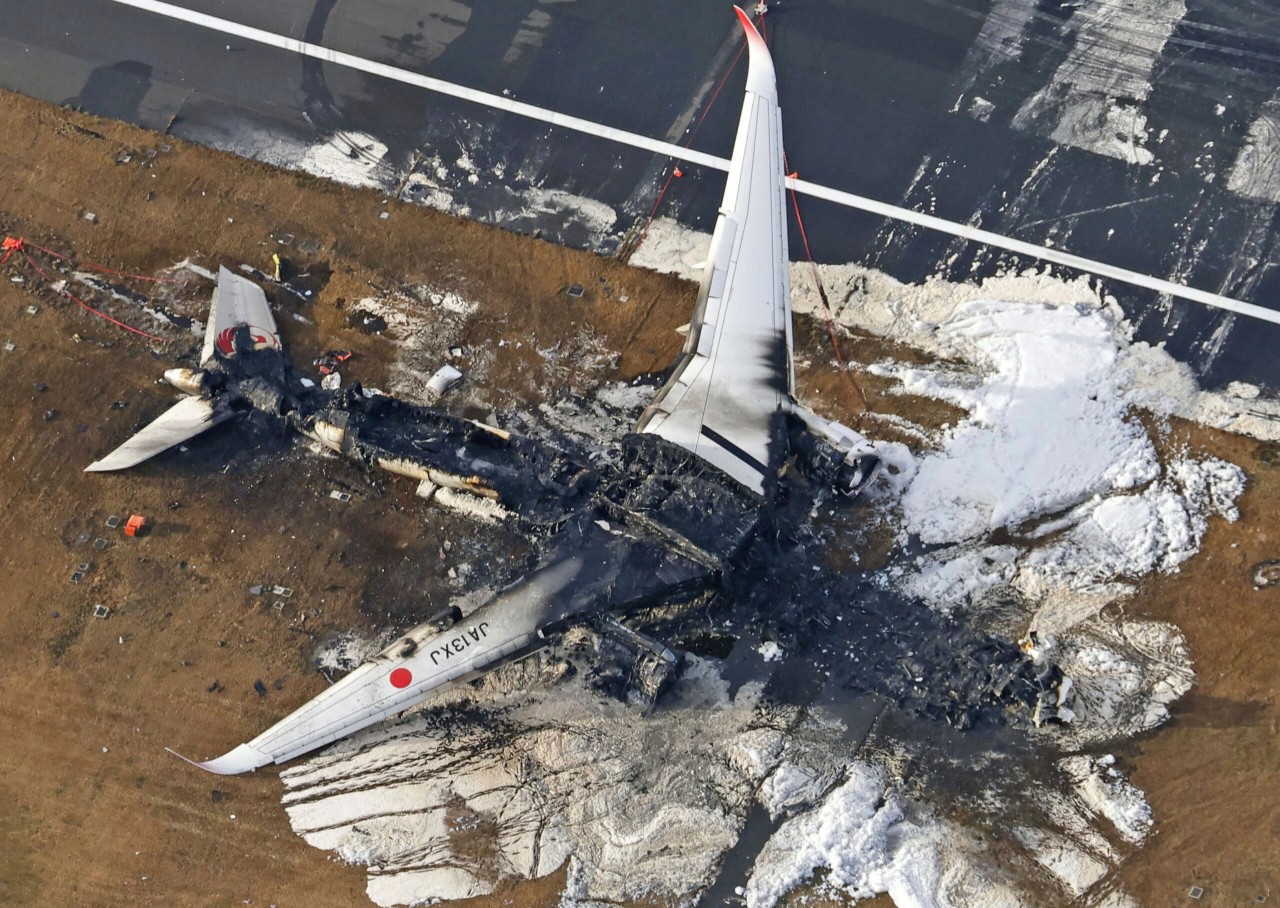
What made the feat of saving 379 lives possible?
The Land of the Rising Sun achieved a feat the whole world had to respect, when every passenger and crew member escaped death by a hair's breadth.
While flames burned fiercely outside the windows, order was maintained in the passenger cabin. Cabin crew evacuated all 367 passengers through 3 of the 8 emergency exits, and no one suffered any serious injury.
All baggage was left behind; passengers carried only their smartphones, thereby recording terrifying footage for the whole world.
Among the factors behind the miracle at Haneda Airport, the following must be mentioned:
- An experienced captain with 12,000 flight hours, and a crew of 12 who were well trained and professional;
- Advanced aircraft design and materials;
- There was no panic on the aircraft during the emergency evacuation.
Point number 3 is perhaps the most important of all. We know that in an emergency people are often afraid and act on the survival instinct, rather than according to the regulations.
If this happens, there will be many casualties as people are trampled to death while fleeing. A horrific sceneItaewon 2022is one example that could not be more striking. Flight JA516 had only 03 extremely narrow emergency exits opened for 367 passengers.
Had there been a stampede, the number of survivors would certainly have been very small.
Public opinion often praises the Japanese for their strong discipline. Yet a considerable number of the passengers were foreigners.
According to psychologists, emotions can spread and behavior can be imitated. When those who lead the way remain calm and follow the rules, other individuals automatically catch that emotion, are reassured, and imitate it.
Recognizing this behavior, the crew also remained calm, helping passengers stay seated and wait their turn to exit, even though flames were raging outside. Fire spreading into the cabin, and smoke rushing in, could have happened at any moment.
An Airbus spokesperson commented: “The Japan Airlines crew’s actions in helping passengers evacuate were as exemplary as a textbook”.
The Japanese sense of discipline
American and Western society upholds individualism, with the symbol of theeagle. The eagle is a solitary species and does not fly in flocks.
By complete contrast, Japanese society prizes collectivism. That may have taken shape because the natural conditions of this island nation are harsh, with earthquakes, volcanoes, and tsunamis in unbroken succession. The Japanese had to rely on one another to survive, and from that a culture formed"Living for the collective".
The interests of the collective are placed above those of the individual. Their core values may include:
- Gi:Responsibility and loyalty (to family or to the organization) reflect a preference for the group over individual interest. This is clearly expressed through the samurai spirit, and also through seriousness at work and loyalty to the company.
- Shūdan shugi:The clearest expression of collectivism is that individuals are usually encouraged or expected to place the group's interests above their own.
- Wa:Harmony in every aspect of life. The Japanese generally try to avoid conflict and maintain harmony between personal relationships and the community.
- Jisei:Self-control and modesty are valued. The Japanese generally do not show off as individuals and try to control their emotions so as not to inconvenience others.
- Kei:Respect for others, especially older people and people in higher positions. This is shown in forms of address, body language, and everyday behavior.
Japanese children are taught these rules by their families from an early age, so that thinking and action become automatic and turn into a conditioned reflex in adulthood.
The “Safety Management System & Human Factors” training program of Hung Viet Consulting
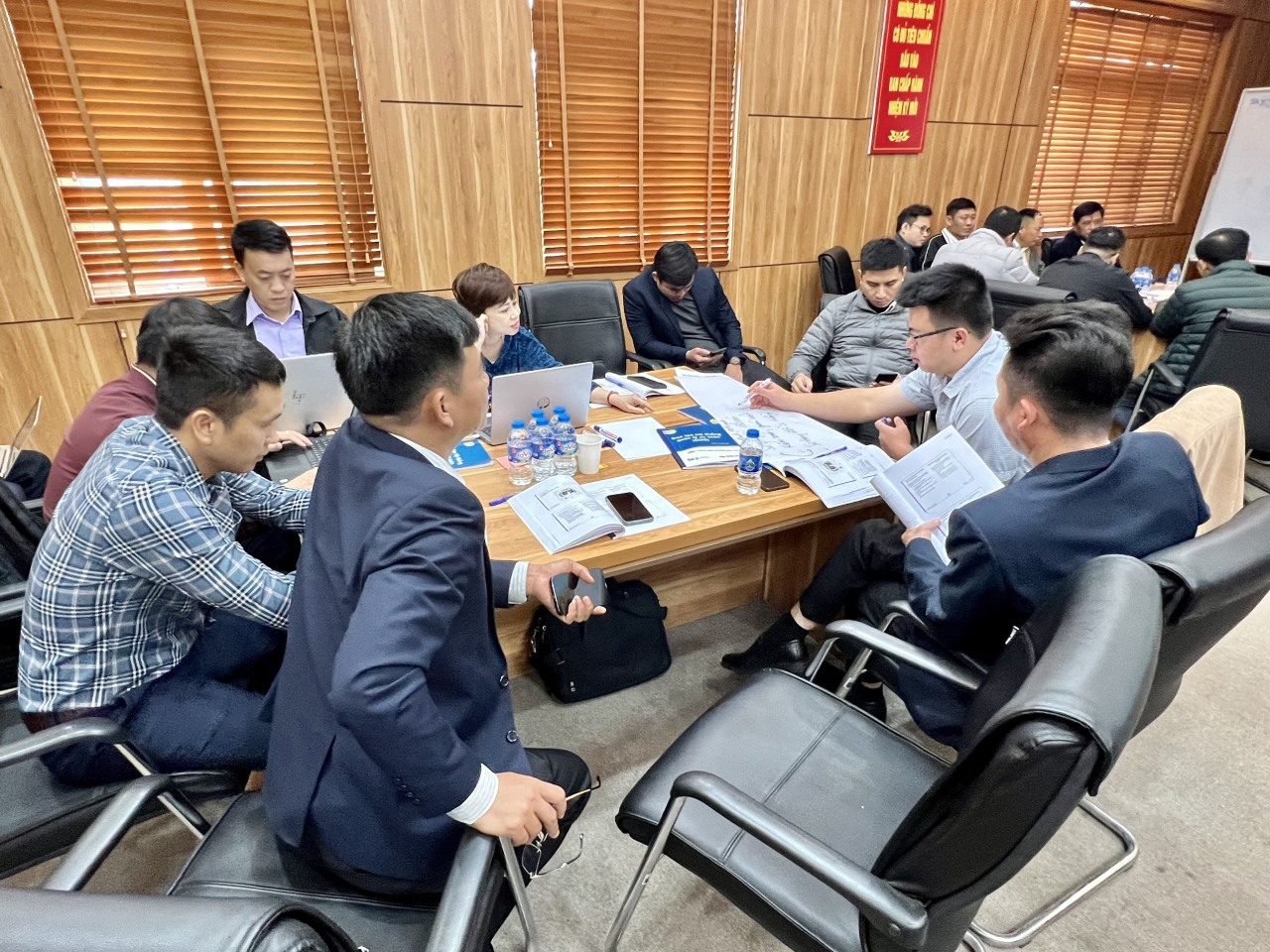
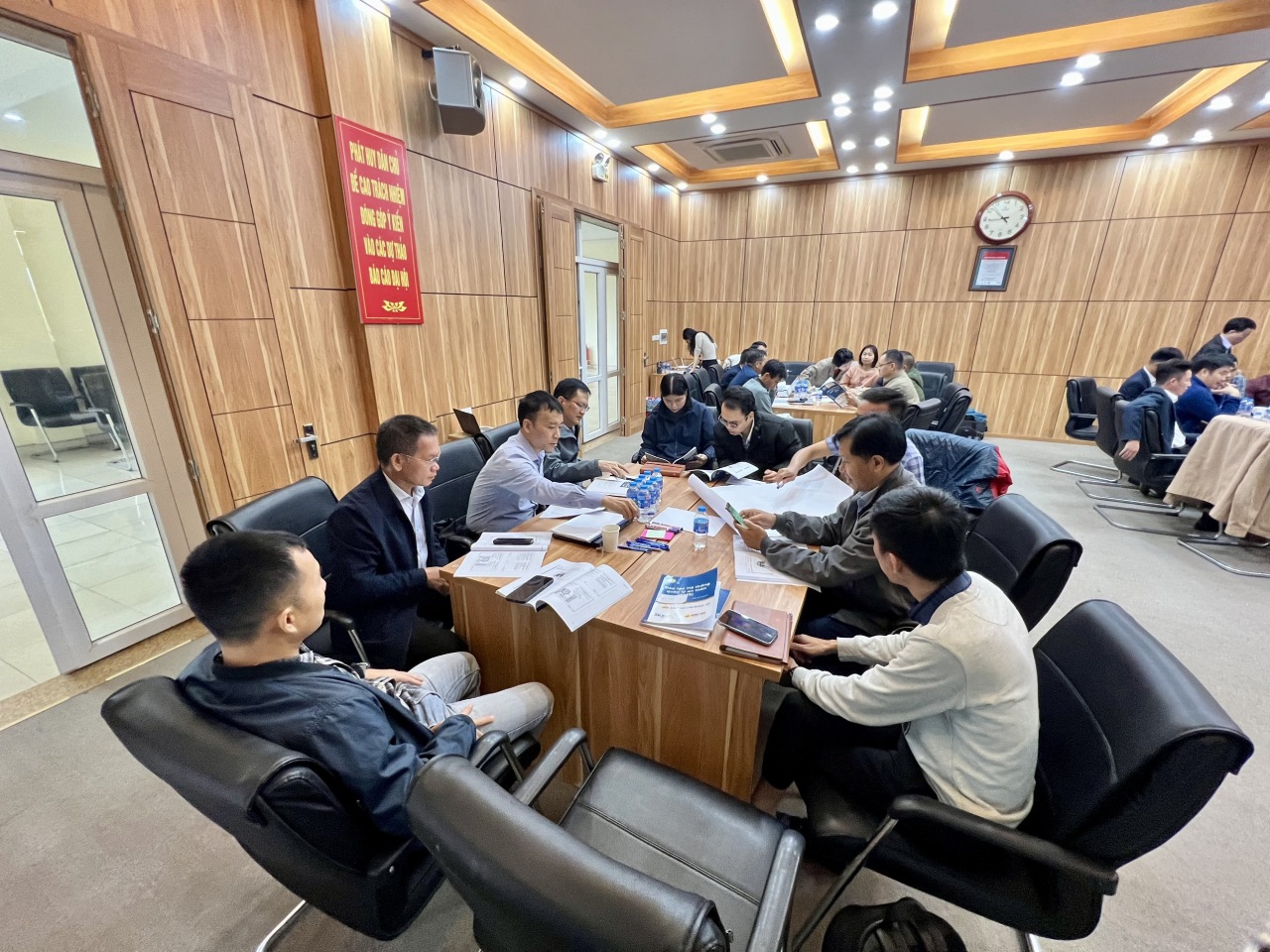
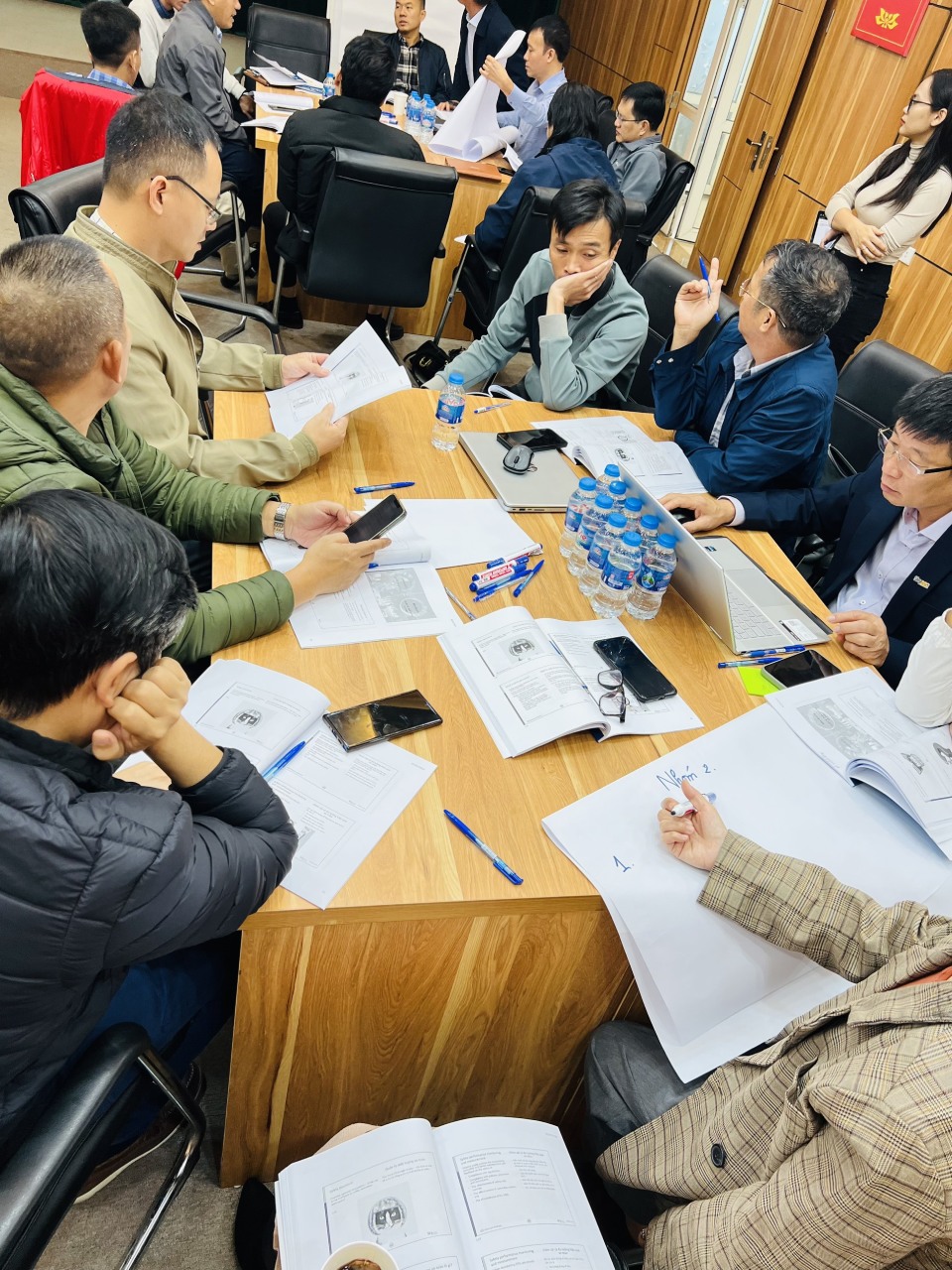
During the 02 days from 03 - 04/01/2024,Hung Viet ConsultingorganizedTraining program “Safety Management System and Human Factors under ICAO Doc 9859"with 40 learners from the branches ofSkypec Aviation Fuel One-Member Limited Liability Company(a member ofVietnam Airlines Corporation - Vietnam Airlines).
The program content focuses on strengthening Safety Culture in enterprise operational management. Within it, the JL516 aircraft accident becomes 1"case study"representative and topical, vigorously analyzed and discussed by experts and participants.
We should not rely entirely on luck. A miracle can occur if the organization, and you yourself, strictly follow safety rules, beginning with building a Safety Culture every day.
Experts affirm that in those life-or-death moments, the prerequisite for a miraculous escape in an aviation accident is:
- Stay as calm as possible.
- Strictly Comply with Flight Crew Instructions.
- Do not try to take luggage when evacuating. Life is what matters most.
- Waiting at the bottom of the slide helps those evacuating after you.
- Do not stop to take photos or film too close to an aircraft involved in an accident. It can explode at any moment.
- Run clear and continue to follow the flight crew's instructions.
A long-standing partner of Vietnam Airlines in introducing, training, implementing, and guiding the work ofSafety - Security, Hung Viet Consulting advised Vietnam Airlines to always regard"Safety is the top priority".
Alongside delivering a premium service experience for customers, Vietnam Airlines Corporation - Vietnam Airlines and its member companies always focus on implementing“Safety Culture”to every employee since 2017.
while continuously maintaining and innovating, with the resolve to turn safety work into“Core culture”, because air transport, by its very nature, requires a high degree of precision and absolute safety.
Vietnam Airlines is expected to hold a workshop withVietnam Air Traffic Management Corporation - VATMon the JL516 aircraft incident, aimed at strengthening coordination in flight management, ground operations, and air traffic control.
RepresentativeHung Viet Consultingwill also share perspectives on safety work here.